
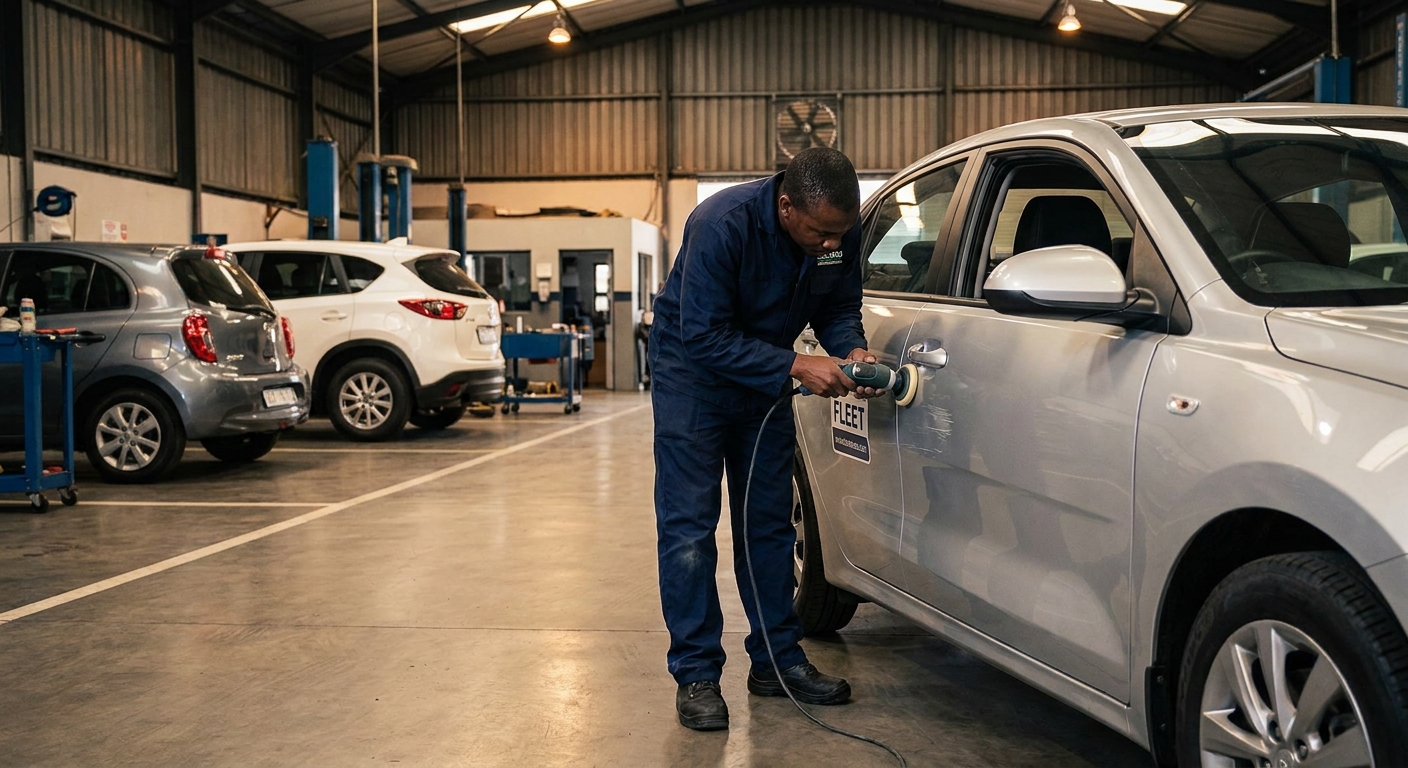
Scratch Repair Fleet Cars South Africa: 2026 Buyer’s Guide
Company cars pick up scratches faster than personal vehicles because more hands touch the same keys, and nobody driving a pool car treats a bumper scratch like it's their own paint job. This guide breaks down scratch repair for fleet cars in South Africa for 2026: what a fleet owner should actually look for, which vehicle types need different handling, and where fleets lose money on repairs that look fine on the surface.
- Scratch repair fleet cars South Africa works best with account-based invoicing and factory paint codes — Metalcross fits that model.
- Toyota Hilux bakkies dominate SA company fleets; panel-only scratch repair beats a full respray for resale value. Buy the panel fix.
- VW Polo pool cars need factory-matched paint codes, not eyeball colour matching under workshop lighting. Skip generic matching jobs.
- Mobile-only scratch operators without a fixed workshop struggle on fleets past 10 vehicles in 2026. Skip mobile-only for larger fleets.
Why this matters
A scratched company car is a resale problem before it's a cosmetic one. Fleet vehicles get traded in or sold on a schedule, and every unrepaired panel gets flagged at the dealer inspection, not just noticed by the next driver.
Most fleet owners don't manage repairs one car at a time — they manage a rolling queue of five, ten, or fifty vehicles cycling through pool duty, delivery routes, and rep visits. A repair process built for a single walk-in customer doesn't scale to that queue, and 2026 fleet budgets don't have room for vehicles sitting idle for a week over a door-panel scratch.
The criteria below aren't about finding the cheapest scratch fix. They're about finding a process that survives contact with a real fleet: multiple vehicles, multiple drivers, one account, one invoice.
Who this is for
This is for the person who signs off on repairs for a business-owned fleet in Gauteng — a fleet manager, an ops lead, or a small business owner running five to fifty company vehicles. If you're comparing quotes for a single personal car, most of this doesn't apply. If you're the one explaining to finance why the Polo pool car has been off the road for nine days, keep reading.
What to look for in scratch repair for fleet cars
Turnaround measured in days, not a vague promise
A fleet vehicle off the road is a cost even when nobody's driving it that week — lease payments and insurance don't pause. The industry standard for a single-panel scratch repair without a full respray is one to three working days once the vehicle is booked in. Anything quoted in weeks should be a red flag for a business fleet.
Colour matching that holds up in daylight
Fleet vehicles are usually the same handful of models in the same factory colours, which sounds like it should make matching easy. It doesn't — factory paint fades unevenly across a vehicle's life, and eyeball matching under workshop lights often shows a visible edge once the car's back in Johannesburg sunlight. Ask whether the shop pulls paint codes or matches by sight.
One invoice, not five
If your fleet runs ten vehicles through the same shop over a year, you don't want ten separate cash transactions and ten separate follow-ups for paperwork. Account-based billing with a single monthly statement is the difference between a repair partner and a repair errand.
A workshop, not just a mobile unit
Mobile touch-up services are fine for a single scratch on a driveway. They're not built for a fleet that needs three vehicles worked on in parallel, or a job that needs a proper spray booth for colour consistency. For fleets over 10 vehicles, a fixed workshop with capacity matters more than convenience.
A clear quote before the car goes in
Getting panel beater quotes online before committing lets a fleet manager compare panel-only repair against a full respray without guessing. A shop that won't quote until the car's already on the ramp is a shop that's going to upsell once you're stuck.
Warranty on the workmanship
A scratch repair that fails in six months costs the fleet twice — once for the original job, once for the redo. Ask what's covered on the paintwork itself, separate from any insurance excess question.
Top picks by fleet vehicle type
The workhorse pick: Toyota Hilux bakkies. Hilux bakkies make up a large share of SA company fleets doing site visits and deliveries, and they take scratches on load bins and side panels constantly. Panel-only scratch and dent repair for Toyota Hilux handles most bin and door scrapes without touching the rest of the panel, which keeps the job to a day or two instead of a full respray cycle. Buy the panel-only route for anything short of structural bin damage.
The pool car pick: Volkswagen Polo. Polos show up constantly as rep cars and pool vehicles across Gauteng, and their factory colours are common enough that shops sometimes get lazy with matching. Scratch and dent repair for Volkswagen Polo in Gauteng done with a factory paint code avoids the mismatch problem entirely. Buy, provided the shop confirms the paint code before spraying.
The SUV pick: bumper scrapes on crossovers and SUVs. Fleet SUVs in Johannesburg pick up bumper scuffs in parking garages more than any other panel, and bumper plastic behaves differently to steel under filler and paint. A shop experienced specifically in SUV bumper work handles the flex-additive paint correctly, where a generalist shop can leave a visible crack line within months. Consider this one if your fleet runs mostly crossovers rather than bakkies or sedans — it's a narrower need but a real one.
The premium pick: executive pool cars. German marques in an executive pool need paint systems and clear coats matched more precisely than mass-market models, and a mismatch on a Mercedes-Benz or BMW is far more visible to a client picking up a rep in that car. Consider a shop with specific experience on premium marques if your fleet includes any executive-tier vehicles — the repair cost difference is small next to the reputational cost of a visible mismatch.
What to avoid
- Verbal-only quotes with no line-item breakdown. Learning how to spot a quality panel beating job before you pay matters more for fleets than individuals, because a bad job repeated across ten vehicles is ten times the cost of one bad job.
- Shops that only do cash-and-carry, no account terms. Fine for a single owner-driver, a real drag on a fleet that needs monthly reconciliation.
- Mobile-only operators for anything beyond a single-vehicle touch-up. Great for a one-off, wrong tool for a fleet running multiple repairs a month.
Verdict comparison
| Fleet vehicle type | Repair approach | Typical turnaround | Verdict |
|---|---|---|---|
| Toyota Hilux bakkie | Panel-only scratch repair | 1-3 working days | Buy |
| Volkswagen Polo pool car | Factory-code colour match | 1-3 working days | Buy |
| SUV / crossover | Bumper-specific respray | 2-4 working days | Consider |
| Executive pool car (BMW/Mercedes-Benz) | Precision clear-coat match | 3-5 working days | Consider |
FAQ
What’s the best scratch repair option for a fleet of company cars in South Africa?
Panel-only repair with account-based invoicing is the best option for most SA fleets in 2026, because it avoids full-respray costs and keeps one invoice per billing cycle instead of scattered cash transactions. It works especially well for common fleet vehicles like the Toyota Hilux and Volkswagen Polo.
Is scratch repair cheaper than an insurance claim for company cars?
For a single panel scratch, a cash-pay repair is usually cheaper once the excess and no-claim bonus impact of an insurance claim are factored in. Larger fleets should compare both routes per incident rather than defaulting to one policy for every scratch.
How long does scratch repair take for a fleet vehicle?
A single-panel scratch repair without a full respray typically takes one to three working days once the vehicle is booked in. Multi-panel damage or a full colour-matched respray takes longer, closer to four to five working days.
Does scratch repair affect resale value on a company car?
Unrepaired scratches and mismatched touch-up paint both show up during a dealer’s trade-in inspection, which can affect the offer on a company vehicle at end of lease or resale. A properly colour-matched repair avoids that flag entirely.
Can a fleet manager get one invoice for multiple vehicle repairs?
Yes, shops that work with business fleets typically offer account-based billing that consolidates multiple vehicle repairs into a single monthly statement. This matters more as fleet size grows past five or six vehicles.
Is mobile scratch repair good enough for a company fleet?
Mobile scratch repair works fine for a single vehicle or a light touch-up, but it struggles once a fleet needs several vehicles worked on in parallel or requires spray-booth conditions for colour consistency. Fleets over 10 vehicles are usually better served by a fixed workshop.
How much does scratch repair cost for a Toyota Hilux bakkie?
Cost depends on whether the job is a panel-only repair or requires a full respray, and current quotes vary by shop and damage extent. Getting a line-item quote before booking the vehicle in is the only reliable way to compare costs.
Should fleet owners use insurance or pay cash for small scratches?
Small, single-panel scratches are usually cheaper to pay cash for once the insurance excess is factored in, while multi-panel or structural damage tends to favor an insurance claim. Fleet owners should decide this per incident, not as a blanket policy.
One last thing
The repair itself is rarely where fleets lose money — the mismatch is. A scratch fixed with the wrong shade under workshop lighting looks fine until the vehicle sits in Highveld sun at a dealer trade-in inspection, and that's the moment it costs the fleet real resale value in 2026, not the day of the repair.
Related guides