
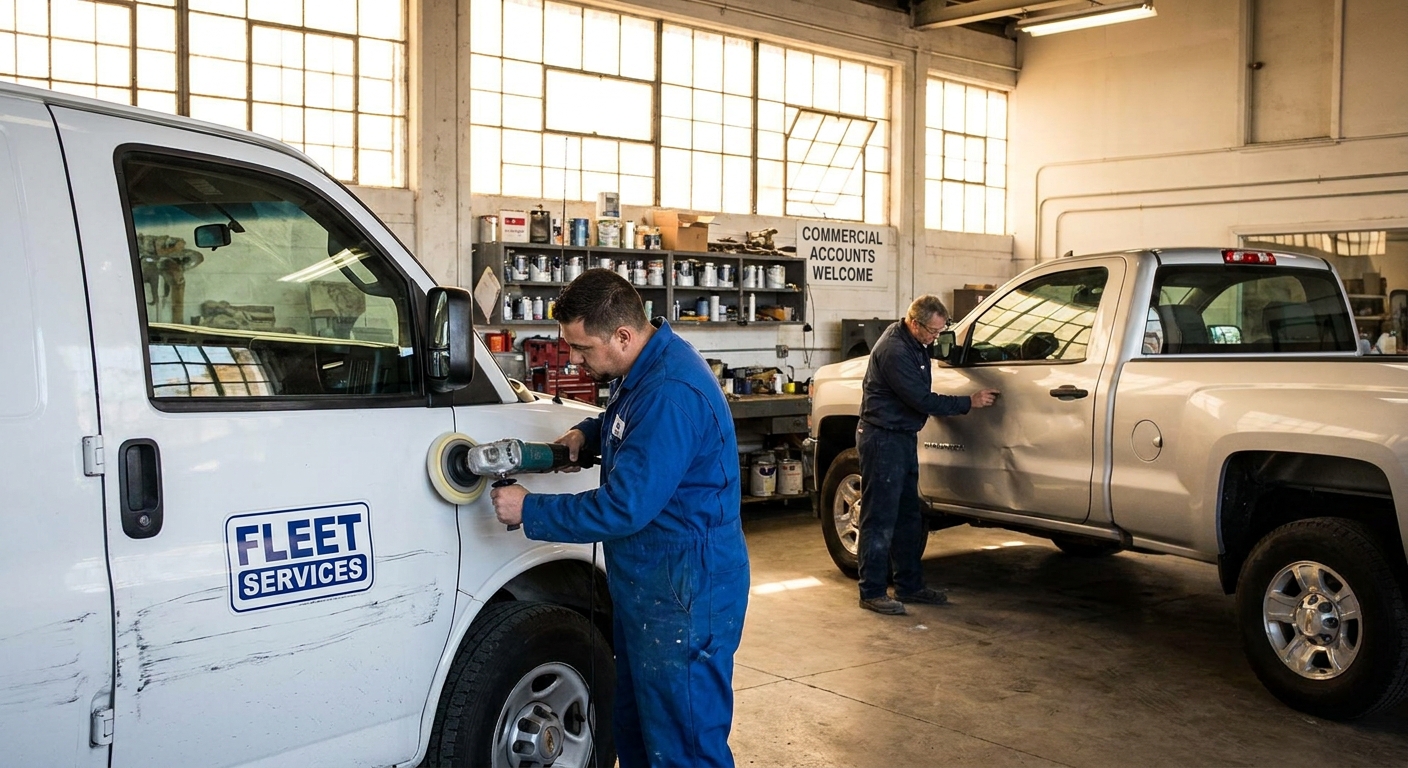
Scratch & Dent Repair for Fleet Vehicles 2026
Fleet vehicles take a beating — and for small businesses running 2 to 20 vehicles, every scratch, dent, and door ding chips away at both resale value and brand image. This guide covers what scratch and dent repair for fleet vehicles actually involves, what separates a good provider from a costly one, and which options make sense depending on your operation size and budget.
TL;DR: Small business fleet operators need scratch and dent repair that is fast, cost-effective, and does not pull vehicles off the road for days. Paintless dent repair (PDR) handles most panel damage in 1–4 hours per panel without respraying. For fleets in 2026, the priority criteria are turnaround time, mobile service availability, per-panel pricing transparency, and whether the provider can batch multiple vehicles in a single visit. Skip body shops that quote per-job rather than per-panel — costs balloon fast across a fleet.
Why this matters for small business owners in 2026
A 5-vehicle delivery fleet with even minor cosmetic damage tells customers one thing: the business does not sweat the details. Beyond perception, unrepaired scratches expose bare metal to rust, which turns a R600 PDR job into a R4 000 respray within 12 to 18 months in a coastal or high-humidity environment. For small businesses with tight margins, that compounding cost is real.
In 2026, the mobile scratch and dent repair market has matured enough that quality providers come to your premises, batch multiple vehicles in one session, and invoice per panel rather than per vehicle. Knowing what to demand from a provider is the difference between a smart fleet maintenance line item and a budget leak.
Who this is for
This guide is written for small business owners and fleet managers running between 2 and 20 vehicles — vans, bakkies, sedans, or light commercial trucks used for deliveries, sales calls, or services. You are not a rental company with a dedicated fleet administrator and insurance repair programme. You are making decisions yourself, watching cost per vehicle, and you need repairs that do not strand a driver.
What to look for in scratch and dent repair for fleet vehicles
Mobile capability
For a small fleet, bringing vehicles to a workshop means lost productivity. A provider with a fully equipped mobile unit comes to your yard or depot and works through multiple vehicles in a single visit. In 2026, any credible scratch and dent specialist serving business clients offers mobile service as standard — if they do not, they are not set up for fleet work.
Per-panel pricing, not per-job
Fleet pricing should be transparent at the panel level. A door dent is a door dent, and the quote should reflect panel size and damage depth, not the fact that you have a bakkie instead of a sedan. Providers who quote "per job" tend to inflate estimates when they see a commercial vehicle. Ask for a per-panel rate card before committing.
Paintless dent repair (PDR) as the primary method
PDR removes dents by massaging the metal back into shape from behind the panel — no filler, no sanding, no repainting. For small business fleet vehicles it is the correct default method because it preserves the factory paint (critical for resale and lease return), takes 1–4 hours per panel, and costs 60–80% less than conventional body shop work. If a provider leads with respraying as the solution for minor dents, walk away.
Batch scheduling and turnaround commitment
A provider who cannot commit to a written turnaround time is not a fleet partner. For small fleets, the standard expectation in 2026 is same-day or next-morning completion for up to 4 panels, and no vehicle off-road for more than 24 hours. Get this in writing before the first booking.
Scratch classification before quoting
Not all scratches are equal. A surface scratch that has not broken the clear coat can be polished out in under 30 minutes. A scratch through primer to bare metal needs different treatment. A provider who inspects and classifies damage before quoting — rather than issuing a blanket estimate — will give you more accurate invoices across the fleet over time. Ask how they categorise damage before asking for a price.
Warranty on repairs
PDR done correctly is permanent — the metal does not have a memory that pulls it back out of shape. Reputable providers back their work with at least a 12-month warranty on dent repairs and a clear coat guarantee on scratch polishing. No warranty is a red flag on any commercial account.
Top picks for fleet operators
The full-service mobile partner — Best for fleets of 5 or more vehicles
A mobile PDR specialist who visits your premises, carries all equipment in a van or trailer, and can work through 4–6 panels per day is the right setup for any fleet above 5 vehicles. The defining spec is panel throughput: you want a provider who can process at least 4 panels in a single site visit. Verdict: Buy — this model gives you predictable scheduling, no transport cost, and a single invoice per session. Metalcross Vehicle Makeover Clinic operates this way for commercial clients in South Africa.
The fixed-location specialist — Best for 2–4 vehicles with flexible scheduling
For very small fleets where one vehicle being off-site for a few hours is manageable, a fixed-location PDR specialist can work well. Look for a provider who can take all your vehicles in the same day rather than booking them across separate appointments. The key number: turnaround of under 3 hours per vehicle for standard dent and scratch work. Verdict: Consider — viable if you have scheduling flexibility, but loses efficiency above 4 vehicles.
The panel beater — For structural damage only
Traditional panel beaters use filler, sanding, and repainting. For cosmetic-only damage — which covers 80% of fleet wear — this is the wrong tool. Panel beater rates in South Africa in 2026 run R2 500 to R6 000 per panel including paint, versus R600 to R1 500 for PDR on the same panel. The quality of the factory paint match is also rarely perfect. Verdict: Skip for cosmetic damage — reserve panel beaters for structural damage, collision repairs, or panels where the metal is creased beyond PDR limits.
DIY scratch repair kits — For drivers, not fleet managers
Retail scratch pens and filler kits cost R80–R250 and are appropriate for individual car owners touching up isolated stone chips. On a commercial vehicle with multiple damage points, inconsistent colour match and poor adhesion become visible within 6 months. Verdict: Skip — the cost savings do not survive a resale or lease inspection.
What to avoid
- Providers who quote without inspection. A photograph-based quote for fleet dent repair is almost always underpriced to win the job, then adjusted upward on the day. Insist on an in-person assessment.
- Per-vehicle pricing on multi-vehicle accounts. Some providers charge a flat call-out fee per vehicle rather than per panel. On a vehicle with 2 small dents, you end up paying the same as one with 6. Negotiate per-panel rates on any account above 3 vehicles.
- Providers who do not carry insurance. A technician working on your fleet vehicles needs their own public liability cover. If they damage a panel during repair, that should not become your insurance claim. Confirm coverage before signing any service agreement.
Verdict comparison table
| Option | Turnaround per panel | Typical cost per panel (ZAR, 2026) | Factory paint preserved | Mobile availability | Fleet-volume pricing |
|---|---|---|---|---|---|
| Mobile PDR specialist | 1–4 hours | R600–R1 500 | Yes | Yes | Yes |
| Fixed-location PDR specialist | 1–4 hours | R700–R1 800 | Yes | No | Sometimes |
| Panel beater | 1–3 days | R2 500–R6 000 | No | No | Rarely |
| DIY kit | 30–60 minutes | R80–R250 | No | N/A | N/A |
FAQ
What is scratch and dent repair for fleet vehicles?
It is the process of removing cosmetic damage — dents, door dings, paint scratches — from commercial vehicles using methods like paintless dent repair or scratch polishing, without full repainting. For fleet operators, the priority is speed and volume efficiency.
Is paintless dent repair safe for commercial vehicles?
Yes. PDR is safe on any vehicle where the panel metal has not been creased or stretched beyond its elastic limit. It preserves the factory paint, which is important for resale value and lease return conditions. In 2026 it is the industry standard for cosmetic fleet repairs.
How much does fleet scratch and dent repair cost in South Africa in 2026?
PDR rates range from R600 to R1 500 per panel depending on dent size and depth. Scratch polishing for clear-coat level damage runs R300–R800. Conventional body shop work starts at R2 500 per panel and rises sharply with paint matching.
How long does scratch and dent repair take on a fleet vehicle?
A skilled PDR technician completes one standard panel in 1–4 hours. A mobile provider visiting your site can process 4–6 panels in a full day. Most small fleets can turn over all cosmetic repairs within 1–2 days without any vehicle being off the road overnight.
Can fleet vehicle dents be repaired without repainting?
In most cases, yes. Paintless dent repair works on any dent where the paint surface has not cracked or chipped. If the paint is broken, a targeted spot respray is needed — but this is still cheaper and faster than repainting the entire panel.
How often should small business fleet vehicles be inspected for dents and scratches?
A quarterly inspection cycle works for most small fleets. Batch repairs every 3 months prevent minor cosmetic damage from progressing to rust or requiring more expensive corrections. High-use vehicles — daily delivery runs, urban driving — may need a 6-weekly cycle.
What is the difference between scratch repair and dent repair?
Scratch repair addresses paint-level damage — cuts in the clear coat or primer — using polishing compounds or localised respray. Dent repair addresses deformed metal using PDR or filler techniques. Many damage points on fleet vehicles involve both, and a proper provider assesses each component separately before quoting.
Does fleet scratch and dent repair affect insurance premiums?
Cosmetic repairs completed outside an insurance claim do not affect premiums. Submitting small cosmetic damage as insurance claims typically does raise fleet policy costs over time. For damage below R3 000 per panel, most fleet operators in 2026 pay out-of-pocket to protect their claims history.
One last thing
The single highest-leverage change most small fleet operators can make in 2026 is scheduling one site visit per quarter with a mobile PDR provider and processing all outstanding cosmetic damage in a single session. Aggregated repairs cost less per panel than individual bookings, the downtime is concentrated rather than spread across the year, and the fleet always looks client-ready. One session every 90 days is usually enough for fleets under 10 vehicles.