
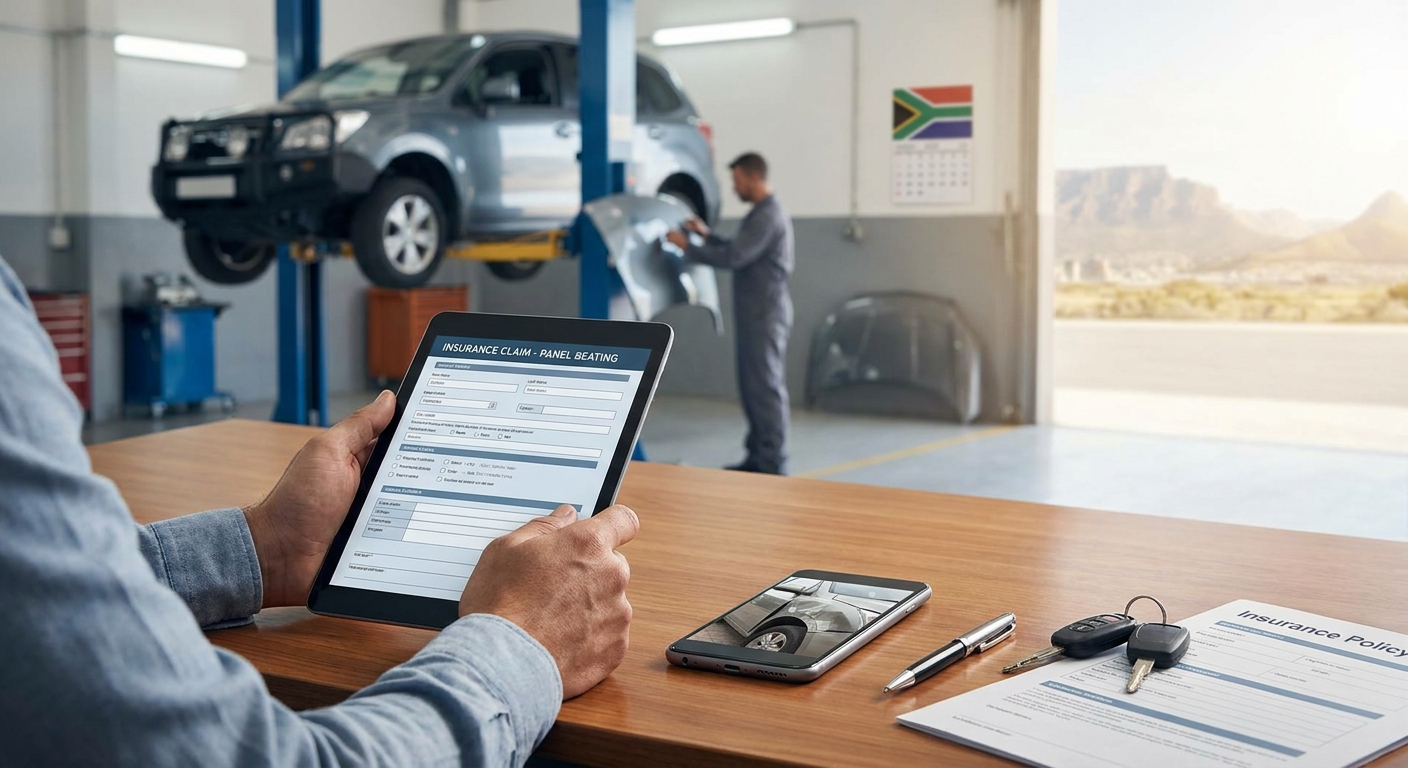
Insurance Claim Panel Beating South Africa 2026 Guide
Filing an insurance claim for panel beating repairs in South Africa is not complicated — but the sequence matters, and one wrong step can cost you the payout or leave you stuck with a repairer your insurer won't honour.
TL;DR: An insurance claim panel beating South Africa process runs in a fixed order: report the accident, get a claim number, have your vehicle assessed, choose an approved or preferred repairer, and sign off only once the work meets your satisfaction. Skipping the assessment or booking repairs before your insurer authorises them is the single most common reason claims get rejected in 2026. Metalcross Vehicle Makeover Clinic works directly with most major South African insurers, which removes several of these friction points.
Why the sequence matters
South African insurers operate on an authorisation model. The repairer cannot legally charge your policy until the insurer has issued a job card or authorisation number. Drivers who book panel beating first and notify their insurer second often discover the invoice won't be covered — no matter how legitimate the accident. In 2026, with repair costs averaging well above R15 000 for moderate panel damage, that gap lands on you.
What you'll need
Before making any call, gather the following:
- Your vehicle registration and licence disc
- Your insurance policy number
- The other driver's details: name, ID or licence number, vehicle registration, insurer name
- Photos of both vehicles at the scene, including road position and any traffic signs
- A case number if SAPS attended (required by some insurers for claims above their excess threshold)
- Your driver's licence
- A dashcam file if you have one (insurers now routinely request this)
Having all of this before your first call cuts average claim opening time from 40+ minutes to under 15.
The steps
Step 1 — Report the accident to your insurer within 24 hours
Most South African comprehensive policies require notification within 24 hours of an incident. Call your insurer's claims line — not the broker — immediately. State the facts plainly: date, time, location, nature of damage, whether there were injuries, and whether police attended. Do not admit fault on the call; that determination is the insurer's job. You'll receive a claim reference number at the end of this call. Write it down. Every subsequent conversation, quote, and repair invoice must carry this number.
Common mistake: Calling the broker to log the claim. Brokers relay the message, but the 24-hour clock runs from the incident — not from when the broker passes it on. Call the insurer directly.
Step 2 — Document the damage thoroughly
Before moving the vehicle to any workshop, photograph every panel, every scrape, and every angle. Take photos in daylight. Insurers use your photos to validate the assessor's report; gaps in documentation give loss adjusters grounds to query whether secondary damage occurred in transit. If the car is driveable, photograph it in its accident position before moving it.
Expected outcome: A timestamped photo set that matches the assessor's written report. Discrepancies between photos and the report are a red flag to claims departments.
Step 3 — Arrange the insurer's vehicle assessment
Your insurer will either send an assessor to inspect the vehicle or direct you to a drive-in assessment centre. This step cannot be skipped. The assessor determines:
- Whether the damage is consistent with your account
- The repair scope (panel beating, respray, part replacement)
- Whether the vehicle is economical to repair or should be written off
In 2026, most major insurers — including OUTsurance, Santam, Discovery Insure, King Price, and Hollard — complete assessments within 2–5 business days in Gauteng metros. If your vehicle is not roadworthy, the insurer typically arranges a tow to an approved facility.
Common mistake: Accepting a verbal repair scope from a panel beater without waiting for the assessor's written authorisation. If the final invoice exceeds the authorised amount, you pay the difference.
Step 4 — Choose your panel beater
Once the authorisation is issued, you select a repairer. South African insurers offer two paths:
- Preferred/network repairer: The insurer directs you to a workshop on their approved list. The insurer manages payment and often guarantees the workmanship for a defined period.
- Own choice repairer: You select a workshop not on the insurer's list. The insurer pays up to their rated labour rate; any shortfall between that rate and the workshop's actual rate is your cost.
Metalcross Vehicle Makeover Clinic is registered with several major insurers as a preferred repairer, which means claims go through without a labour rate gap. Check panel beaters near me — how to choose the right one for the questions you should ask any workshop before handing over your keys.
Common mistake: Assuming "approved" means the same thing across all policies. Always confirm your specific insurer recognises the workshop before dropping the vehicle.
Step 5 — Review and sign the repair scope before work starts
The workshop should give you a written repair order that matches the authorised scope. Read it. Anything listed on the repair order but not on the authorisation is a potential dispute point. If you notice a panel listed that was not visibly damaged, raise it with the insurer before work begins — not after.
Some insurers send a supplementary authority if the repairer discovers hidden damage (for example, a bent chassis rail behind an intact bumper skin). This is normal. The repairer pauses work, the insurer re-assesses, and a revised authorisation is issued. The process adds 1–3 days but protects both you and the insurer.
Step 6 — Inspect the vehicle before signing off
Do a walk-around with the workshop manager when you collect the car. Check:
- Colour match under daylight, not fluorescent workshop lighting
- Panel alignment — gaps should be even and consistent with adjacent panels
- No orange peel or fish-eye in the respray
- Clips, trim, and rubber seals refitted correctly
- Any mechanical items disturbed during repair have been tested (boot latch, bonnet catch, headlights)
Do not sign the satisfaction note until you are satisfied. Once signed, the insurer considers the claim closed. If you discover a paint defect two days later, you reopen against the workshop's guarantee — not the insurer's claim.
Expected outcome: A fully repaired vehicle with a signed completion certificate and the workshop's workmanship guarantee in writing.
Step 7 — Pay your excess and confirm the claim is closed
Your excess is payable directly to the repairer, not the insurer. The amount is stated on your policy schedule. Confirm the claim closure reference with your insurer — this protects your no-claim bonus record if the system takes time to update.
If the third party was at fault and your insurer paid your claim, they will pursue the third party's insurer for recovery. This is called subrogation. It does not affect your no-claim bonus if your insurer records the claim correctly.
Troubleshooting
The insurer says the vehicle is a write-off but you disagree. Request the settlement offer in writing and check whether it reflects current retail value. The Short Term Insurance Ombudsman handles disputes; the 2026 turnaround for written submissions is typically 6–8 weeks.
The assessor's repair scope misses obvious damage. Do not accept the vehicle into the workshop until the scope is corrected. Call your insurer's claims line with the claim reference and request a supplementary assessment. The repairer can support this request in writing.
The workshop is quoting above the insurer's authorised amount. Get the difference itemised. If the gap is due to parts pricing (OEM vs. pattern parts), ask your insurer whether OEM uplift is a benefit on your policy — some policies include it, others don't.
Your claim is rejected for late notification. Request the rejection in writing. If the delay was caused by hospitalisation or circumstances beyond your control, lodge a formal reconsideration with supporting documentation. The Ombudsman for Short-Term Insurance handles these escalations at no cost.
The colour match is poor after collection. Return to the workshop within the guarantee period. Most panel beaters guarantee paint for 12 months minimum. If the workshop refuses, escalate to the insurer — they carry reputational risk over preferred repairers.
Your excess was charged twice. This happens occasionally when a claim is logged twice in error. Provide the workshop receipt and the insurer's settlement confirmation to your broker or insurer for a refund.
Tools and resources
- Your insurer's 24-hour claims line (stored in your phone before you need it)
- SAPS case number confirmation (request a J88 or case number at the scene)
- How to get panel beater quotes online in South Africa — useful if you are comparing costs before deciding between network and own-choice repairer
- Bumper repair for SUVs in Johannesburg — if your claim involves bumper-specific work on a larger vehicle
- The Short-Term Insurance Ombudsman: 0860 726 890
- Metalcross Vehicle Makeover Clinic at metalcross.co.za works with most major South African insurers and can assist with the authorisation process from Step 3 onward
What to do next
If you are still in the quote or repairer-selection stage, read best panel beaters in Fourways 2026 — it covers exactly what separates an insurer-ready workshop from one that will cause delays in the authorisation chain.
FAQ
What is the time limit to claim insurance for panel beating repairs in South Africa?
Most policies require notification within 24 hours of the incident. The formal claim submission deadline is typically 30 days, but notification is the critical window — missing it is the most common grounds for rejection in 2026.
Can I choose my own panel beater for an insurance claim?
Yes. South African law does not compel you to use the insurer's preferred repairer. However, using an out-of-network workshop means you may pay the difference between the insurer's authorised labour rate and the workshop's actual rate.
How long does an insurance claim for panel beating take in South Africa?
From notification to vehicle collection, straightforward claims run 7–14 business days in 2026. Complex structural damage or parts delays can stretch this to 4–6 weeks.
Do I pay my excess to the insurer or the panel beater?
You pay the excess directly to the panel beater before or on collection of your vehicle. The insurer pays the balance of the authorised amount directly to the workshop.
Will claiming for panel beating affect my no-claim bonus?
Yes, in most cases a comprehensive claim resets or reduces your no-claim discount at renewal. Some policies offer a no-claim protector benefit — check your policy schedule.
What happens if the panel beater finds extra damage not in the original quote?
The repairer submits a supplementary assessment request to your insurer. Work pauses until the insurer issues a revised authorisation. You should not be billed for supplementary work without insurer sign-off.
Is a police case number required for all panel beating insurance claims?
Not always. Minor single-vehicle damage (scraping a bollard, for example) often does not require a case number. Third-party collisions almost always do. Confirm with your insurer when you log the claim.
Can Metalcross Vehicle Makeover Clinic handle the insurer authorisation process on my behalf?
Metalcross Vehicle Makeover Clinic liaises directly with most major South African insurers. Once you have a claim reference number, the workshop can manage the assessment scheduling and authorisation follow-up from that point.
One last thing
The Short-Term Insurance Ombudsman resolved over 9 000 formal complaints in the most recent reporting year — and the single largest category was claims repudiation due to policyholder error in the notification or documentation stage. Getting the sequence right in 2026 is not bureaucracy; it is the difference between a fully paid repair and a bill that lands in your lap.