
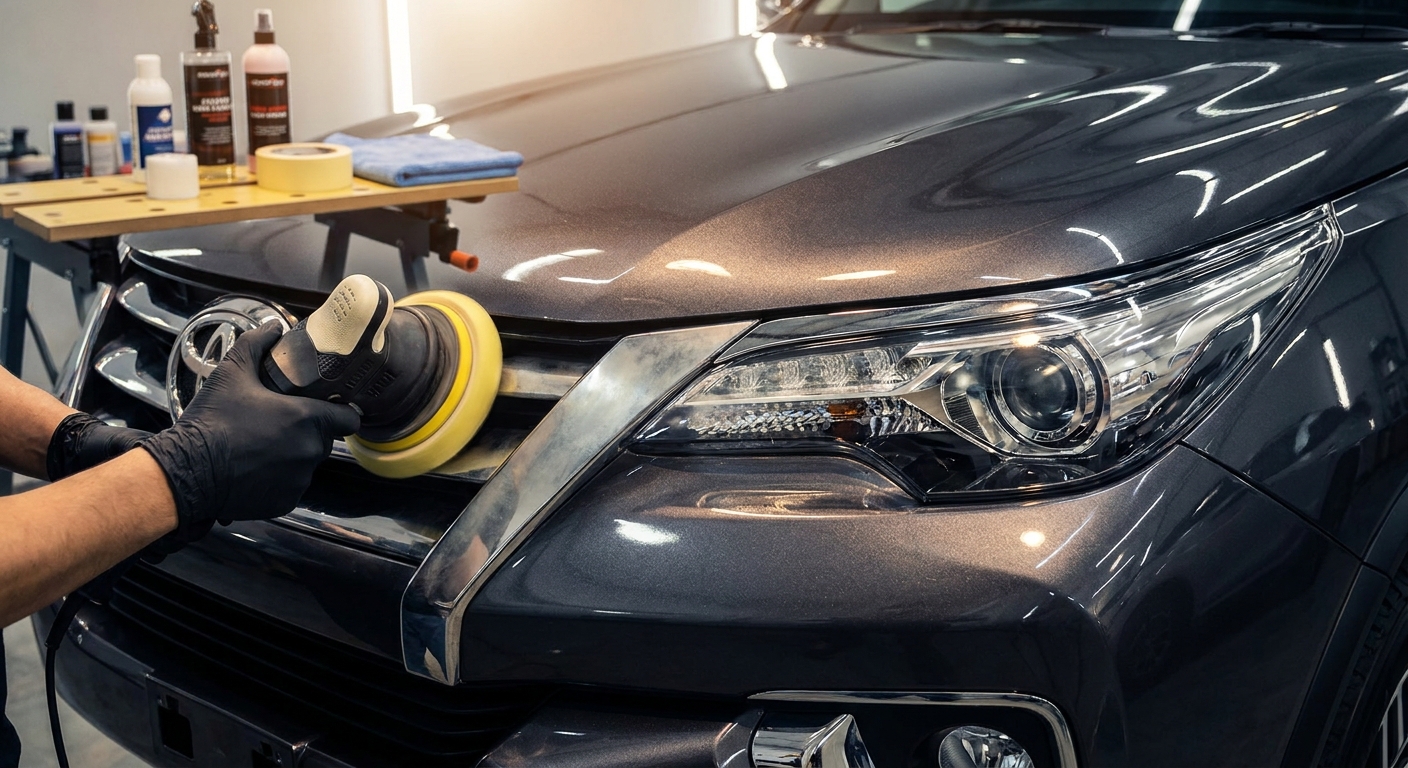
Headlamp Restoration for Toyota Fortuner: Buy or Skip 2026
Toyota Fortuner headlamps cloud over faster than most SUVs on South African roads, and picking the wrong fix wastes money twice – once on the job, once on the redo. This guide ranks the real options for headlamp restoration for Toyota Fortuner owners and tells you which one to book, which one to skip, and when replacement is the only honest answer.
TL;DR
Headlamp restoration for Toyota Fortuner comes down to four real choices: DIY kits, a professional wet-sand-and-recoat, insurance-routed restoration, and full assembly replacement. A wet-sand recoat is the Buy for a Fortuner with intact lenses and no deep pitting – it restores beam output and holds up for 2-3 years under Gauteng sun. DIY kits are a Consider at best. Insurance-covered restoration is a Buy when hail or stone-chip damage is already on the claim. Full replacement is a Skip unless the housing itself is cracked, not just cloudy.
Why this matters
A Fortuner's headlamp lens is polycarbonate, not glass, and polycarbonate degrades under UV exposure years before most owners notice. By the time the lens looks yellow or milky, the factory UV coating underneath has usually already failed – which is exactly the restore vs replace call this guide is built around.
Cloudy lenses aren't cosmetic. A degraded lens scatters light instead of focusing it, which cuts real beam distance at night and can fail a roadworthy light-output check. Fixing it properly – not just polishing the surface – is the difference between a fix that lasts to 2028 and one you're redoing by mid-2027.
Who this is for
This guide is for Fortuner owners – 2016-2019 facelift models and 2020-onward – whose headlamps have gone yellow, hazy, or dim, and who need to decide between a DIY kit, a professional restoration, an insurance-routed repair, or a full replacement before their next roadworthy or resale.
What to look for in headlamp restoration for a Fortuner
Lens condition, not just colour
Haze and yellowing are surface-level UV damage; pitting and cracking are structural. A lens that's only hazy responds well to wet-sanding and recoating, but a pitted or cracked lens won't hold a new clear coat no matter how good the polish job is.
Housing seal integrity
Fortuners older than five years often show condensation inside the headlamp housing, which means the seal has already let moisture in. Restoring the outer lens while ignoring a failed seal just traps moisture behind a shiny new coat – it fogs again within months.
UV-resistant clear coat quality
The clear coat is what actually stops the next round of oxidation, not the sanding. A proper 2K UV-resistant coat holds for 2-3 years in Johannesburg's sun exposure; a spray-can DIY coat typically breaks down in 3-6 months.
Reflector and projector cleanliness
On Fortuners with projector-style lamps, the reflector behind the lens yellows too, and no amount of outer-lens polishing fixes internal haze. Any shop working the lens needs to check the reflector, not just the visible surface.
Roadworthy and beam compliance
South African roadworthy testing checks headlamp output and aim, and a badly restored or incorrectly reassembled housing can throw the beam pattern off. This matters more on a Fortuner than a hatchback, given how many are used for long-distance and game-farm driving where beam reach counts.
Turnaround and mobile availability
A fleet or daily-driver Fortuner can't sit in a shop for a week over a headlamp job. Confirm turnaround before booking – a proper wet-sand recoat should take roughly 45-90 minutes per lamp in-shop, not days.
Top picks for Fortuner headlamp restoration
The safe pick: professional wet-sand and UV recoat
This is the standard fix for a hazy, oxidized lens with no cracks. The process runs through 400, 800, then up to 3000-grit wet sanding before a UV-resistant clear coat goes on, and the finished coat typically holds for 2-3 years before it needs redoing. Verdict: Buy – this is the default move for most Fortuner owners in 2026 with surface haze and an otherwise sound lens.
The budget gamble: DIY restoration kit
Hardware-store kits use similar sanding grits but skip the professional-grade UV clear coat, relying instead on a consumer spray sealant. Most DIY jobs look good for 3-6 months, then the haze creeps back faster than it did the first time because the lens is now thinner from sanding. Verdict: Consider only if you're planning to redo it again within a year or selling the vehicle soon.
The paperwork pick: insurance-routed restoration
If your Fortuner's headlamp damage is tied to hail, a stone chip crack, or an accident that's already on a claim, restoration or replacement can often be bundled into that claim instead of paid out of pocket. Working through the process outlined on how to claim insurance for panel beating repairs before booking saves you from paying for something the claim should cover. Verdict: Buy if the damage is already claim-eligible – don't pay cash for something insurance owes you.
The permanent fix: full headlamp assembly replacement
When the lens is cracked, the housing has failed, or moisture damage has corroded the internal reflector coating, restoration won't hold no matter how good the recoat is. Replacement resets the clock completely, but it's the highest-cost option of the four and only makes sense when the housing itself is compromised, not just the surface. Verdict: Skip unless the housing is physically damaged – restoration handles surface haze for a fraction of the disruption.
The convenience pick: mobile/express restoration
Some shops offer an on-site or same-day wet-sand-and-recoat for owners who can't leave a Fortuner parked for a full workshop visit. The trade-off is usually a shorter clear-coat cure window before the vehicle can be driven in rain, so confirm cure time before you book a same-day slot. Verdict: Consider for daily drivers and small fleet vehicles where downtime is the real cost, not the job itself.
What to avoid
- Polish-only detailing with no clear coat – it looks fixed for a week, then the haze returns faster than before because the protective UV layer was never replaced.
- Aggressive sanding without reflector protection – overspray or grit ingress can permanently dull the chrome reflector behind the lens, and that's not something a lens recoat fixes.
- Unapproved aftermarket LED retrofit kits sold as a "restoration upgrade" – swapping bulb type without correct housing compatibility can throw beam pattern out of roadworthy spec.
Verdict comparison table
| Method | Best for | Durability | Turnaround | Verdict |
|---|---|---|---|---|
| Wet-sand + UV recoat | Hazy, uncracked lens | 2-3 years | 45-90 min per lamp | Buy |
| DIY kit | Short-term fix, resale prep | 3-6 months | Same day | Consider |
| Insurance-routed restoration | Hail/stone-chip claims | 2-3 years | Depends on claim | Buy |
| Full assembly replacement | Cracked housing, corroded reflector | Long-term | Longer lead time | Skip unless damaged |
| Mobile/express recoat | Daily drivers, fleets | 1-2 years | Same day, on-site | Consider |
FAQ
What causes Toyota Fortuner headlamps to go yellow or cloudy?
UV exposure breaks down the factory clear coat on the polycarbonate lens, and once that coat fails the lens oxidizes and turns hazy or yellow. It's a chemical breakdown, not dirt, so wiping or washing the lens won't remove it.
Is headlamp restoration worth it for a Fortuner?
Yes, for lenses that are hazy but not cracked – a professional wet-sand recoat restores beam output and typically holds for 2-3 years. It's cheaper and faster than replacement, provided the housing itself is sound.
How long does headlamp restoration last on a Fortuner?
A proper UV-resistant recoat holds for roughly 2-3 years under normal Gauteng sun exposure. A DIY spray-can job usually fails within 3-6 months because the sealant isn't UV-stable enough.
Can I restore Fortuner headlamps myself with a DIY kit?
You can, and it will look better for a few months, but the fix doesn't last as long as a professional wet-sand-and-recoat because most kits skip the proper 2K UV clear coat. Treat it as a temporary fix, not a permanent one.
What's the difference between headlamp restoration and replacement?
Restoration resurfaces and recoats an intact lens; replacement swaps the entire housing when it's cracked, corroded, or seal-failed. Restoration only works if the lens and housing are structurally sound.
Does headlamp condition affect roadworthy testing in South Africa?
Yes – roadworthy checks include headlamp output and beam aim, and a badly oxidized or poorly restored lens can scatter light enough to fail that check. A correctly restored or replaced lamp resolves this.
How often should Fortuner headlamps be restored?
Most owners in Gauteng's sun exposure need a recoat every 2-3 years to stay ahead of oxidation. Waiting until the lens is fully opaque means driving with reduced night visibility in the meantime.
Is insurance-covered headlamp restoration worth pursuing?
If the damage is tied to hail, a stone chip, or an accident already on a claim, yes – it avoids paying out of pocket for something the policy should cover. Confirm claim eligibility before booking a cash job.
One last thing
Most Fortuner owners wait until the lens looks visibly opaque before booking anything, but the UV coating underneath usually fails months before the haze becomes obvious to the eye. By the time you can see the cloudiness, the lens has typically already lost meaningful light output at night – which is the exact gap between when restoration is easy and cheap, and when it turns into a replacement conversation.