
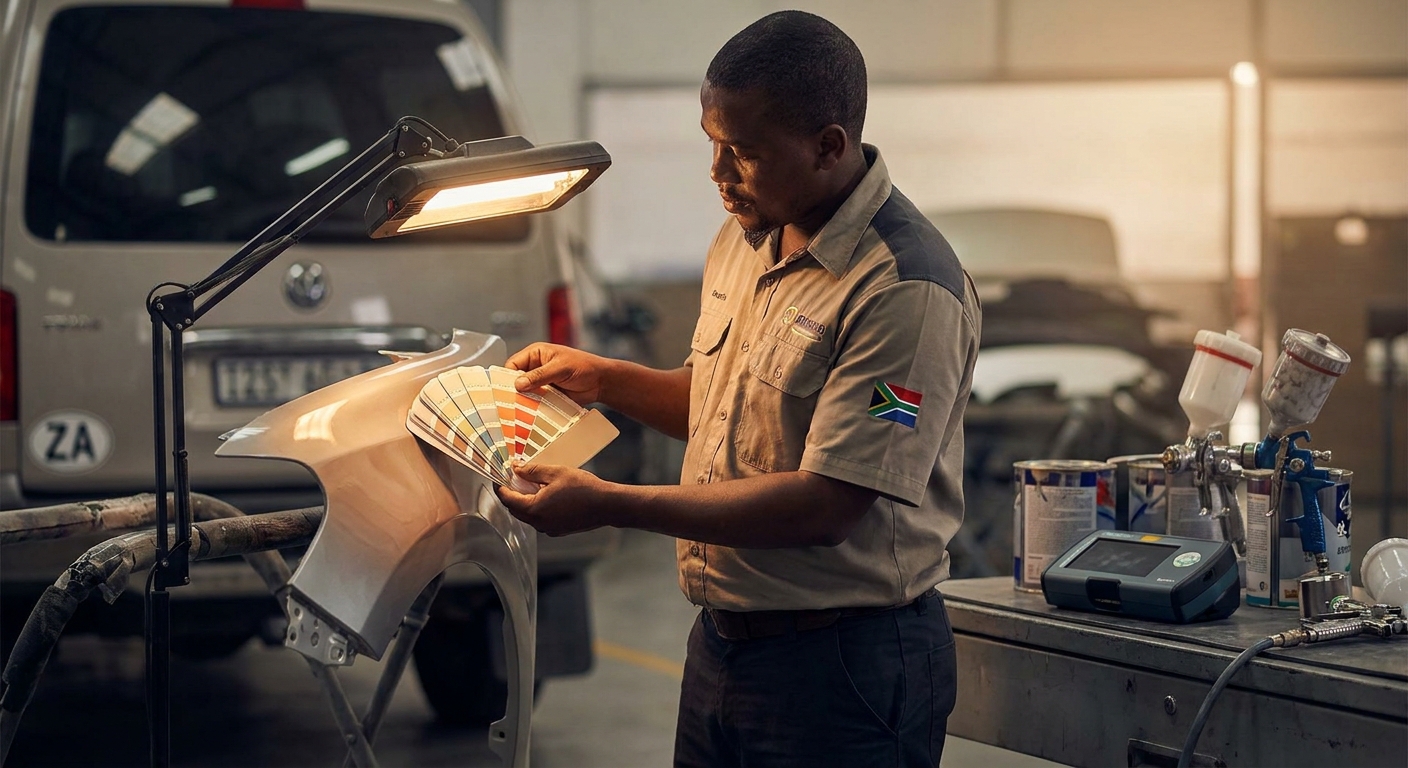
Colour Matching Panel Beating South Africa 2026
Colour matching after a dent or scratch repair is the difference between an invisible fix and a panel that screams "this car got hit." Here's exactly how professional colour matching works in South Africa, and how to check a panel beater is doing it right.
TL;DR: Colour matching panel beating in South Africa relies on the vehicle's paint code, a spectrophotometer reading, and a hand-blended tint to account for age and fading. Metalcross Vehicle Makeover Clinic uses code-plus-spray-out matching on every repair, and that combination is the verdict: Buy this process, skip any shop that sprays straight from a code without a test panel. Expect one to three days added to a repair timeline for proper colour work, and budget for a spray-out card if your car is older than six or seven years, because factory colour fades unevenly and the code alone won't get you there in 2026.
Why this matters
A botched colour match is the single biggest reason people notice their car was ever damaged. It's not the dent that gives it away later, it's a bumper that's a half-shade too blue next to a faded bonnet.
South African roads add another wrinkle: intense UV exposure fades paint faster here than in cooler climates, so a 2019 Toyota's factory white is rarely the same white it left the factory with. That's why car paint restoration for older vehicles often needs more than a code lookup — it needs a trained eye and a test spray. Get the colour wrong and you're paying twice: once for the repair, once to redo it.
What you'll need
Before any colour matching starts, a proper job requires:
- The vehicle's paint code (usually on a plate in the door jamb, engine bay, or glovebox)
- A spectrophotometer or colour-reading tool to measure the actual current shade
- Test spray cards or a scrap panel to trial the mix before it touches your car
- A mixing system with base tints (most reputable shops run a national brand system updated regularly)
- A controlled spray booth with correct lighting, because natural light and fluorescent light show colour differently
- Time — rushed colour matching is the number one cause of visible panel lines
If you're comparing shops before booking, ask whether they own a spectrophotometer or estimate by eye. That one question filters out a lot of the market fast.
The steps
1. Pull the factory paint code
Every vehicle sold in South Africa carries a manufacturer paint code, usually a 3-6 character alphanumeric string. This gives the shop a starting formula, not a final answer.
Why it matters: the code tells you what colour the car was when it left the factory, not what colour it is today. Skipping this step means guessing from scratch, which takes longer and costs more in wasted paint.
Common mistake: assuming two cars with the same code will match. Batch variations from the manufacturer mean two "identical" codes can differ slightly even brand new.
2. Take a spectrophotometer reading
A spectrophotometer reads the actual reflected colour off your panel in multiple light angles, not just straight-on. This catches metallic and pearl finishes that shift depending on viewing angle.
Why it matters: this is the step that accounts for years of UV fade, previous touch-ups, and panel-specific wear. A bonnet that's baked in Highveld sun for eight years won't read the same as a shaded boot lid on the same car.
Expected outcome: a digital formula adjustment layered on top of the factory code, tailored to your specific panel.
3. Mix the tint and spray a test card
The paint technician mixes the adjusted formula and sprays it onto a test card or a hidden section of scrap metal, never straight onto your car first.
Why it matters: paint looks different wet than dry, and different under booth lighting than in daylight. The test card gets checked in both conditions before committing.
Common mistake: shops under time pressure skip the test card and spray directly onto the repair panel. If it's wrong, you're now looking at a full respray instead of an adjustment.
4. Compare against the vehicle in daylight
The test card gets held against the actual car, outside the booth, in natural daylight. Indoor lighting flatters colour matches that fall apart the moment you step outside.
Why it matters: this is the real test. A match that looks perfect under booth fluorescents can show a visible edge in overcast Highveld daylight or bright midday sun.
Expected outcome: sign-off on the formula, or a return to step 3 for adjustment. A good shop will do this loop two or three times without complaint.
5. Blend the edges, don't just fill the panel
Rather than spraying paint that stops sharply at the repaired panel's edge, the technician blends outward into the adjoining panel, softening any transition.
Why it matters: even a near-perfect colour match can show a hard edge if it's not feathered into neighbouring panels. Blending is what makes a repair genuinely invisible rather than "pretty close."
Common mistake: stopping the blend exactly at the panel seam. Professional blends extend 10-15cm past the repair zone.
6. Clear coat and cure
The clear coat goes on last, protecting the colour layer and giving it the correct gloss level to match the rest of the vehicle. Curing time in a proper booth typically runs one to two hours before the panel is safe to handle.
Why it matters: mismatched gloss levels (too shiny or too matte) are as noticeable as a colour mismatch, especially on metallic and pearl finishes.
Expected outcome: uniform sheen across old and new paint when viewed from multiple angles.
7. Final daylight inspection
Before the car goes back to you, it gets a final walk-around in natural light, checking every angle the repaired panel is visible from — not just head-on.
Why it matters: this catches any residual mismatch before you drive off, when it's still cheap and fast to fix.
Troubleshooting
The colour looks right in the shop but wrong at home. Booth lighting differs from your driveway or garage. Always ask to view the finished panel outside in daylight before signing off, and don't accept "it'll settle" as an answer.
There's a visible line at the panel edge. This usually means the blend wasn't feathered far enough, or the base coat wasn't wet-sanded smoothly before clear coat. This needs to go back for reblending, not a fresh coat on top.
Metallic paint looks patchy or has a mottled texture. Metallic and pearl finishes need even spray-gun passes at a consistent distance. Patchiness points to inconsistent technique, and it's a rework, not a top-coat fix.
Your insurer's approved shop won't do a spray-out test. Push back. If you're going through insurance claim procedures for panel beating repairs, you're entitled to ask what colour-matching process the shop follows before work starts.
The repaired area is a shade lighter after a few weeks. New paint can look slightly different once fully cured, usually within 30 days. If the gap widens rather than closes, that's a formula error, not normal curing.
You can't tell if a quote includes proper colour matching. Ask directly whether the quote includes a spectrophotometer reading and test spray, or just a code-based mix. This single question separates budget respray jobs from proper colour-matched repairs.
Tools and resources
- Your vehicle's paint code (door jamb or engine bay plate)
- A shop with an in-house spectrophotometer, not an outsourced colour lab
- Panel beater quotes gathered online so you can compare whether colour-matching process is even mentioned
- A checklist question for any shop: "Do you spray a test card before the panel?"
- If you're unsure which shop to trust in your area, guidance on choosing the right panel beater covers the vetting questions worth asking beyond price
FAQ
What is colour matching in panel beating?
Colour matching is the process of mixing touch-up or repair paint to match a vehicle's exact current shade, accounting for factory code plus fading, using tools like a spectrophotometer and test spray cards. It's standard practice on any quality repair in South Africa in 2026.
How much does colour matching cost in South Africa?
Colour matching is typically built into the panel and paint repair quote rather than charged separately, though older or heavily faded vehicles may need extra test-spray time. Get an itemised quote and ask if spectrophotometer matching is included.
Is colour matching from a paint code accurate enough on its own?
No. A paint code gives a starting formula, but UV fade, prior touch-ups, and manufacturing batch variation mean the code alone rarely produces an exact match on a vehicle older than two or three years.
How long does colour matching add to a repair timeline?
Expect one to three additional days for proper colour matching versus a quick respray, mostly for test cards, daylight checks, and re-adjustment loops if the first mix isn't right.
Can colour matching fix a mismatch from a previous bad repair?
Yes, in most cases. A shop with proper spectrophotometer equipment can re-read the current panel colour and correct a prior mismatch, though it may require respraying a wider area than the original repair.
Does colour matching work the same for metallic and solid colours?
No. Metallic and pearl finishes are harder to match because they shift with viewing angle and light, requiring more careful spray-gun technique and multiple test angles compared to solid colours.
Will hail damage repair need colour matching too?
Yes, if any panels needed paint rather than pure dent removal. Straight paintless dent repair on hail damage in Gauteng often avoids colour matching entirely, but any panel that needed filler or a full respray will need it.
How do I know if a panel beater did colour matching properly?
Ask to see the finished repair in natural daylight from multiple angles before you accept the car. A confident shop will show you without hesitation; a shop that rushes you inside under booth lighting is one to question.
One last thing
Most people assume a bad colour match means the shop used cheap paint. It's almost never the paint brand, it's almost always a skipped test-spray step under time pressure. Ask any shop one question before you book: "Can I see the test card compared against my car in daylight before you commit?" If they hesitate, that tells you more than any quote will.